

Which one of these four DIYer Types are you?
Before we dive into the science of DIY, see if you recognize anybody here.
The person who finishes everything he starts.
The person who starts everything and finishes nothing.
The person who's been researching the same build for two years.
The person who does absolutely nothing until the deadline, then does it all in one weekend.
One of those four is you. Keep reading and you'll know which.
There's a project sitting in your garage right now that you haven't touched in months.
You know the one. It's been there six months. Maybe six years. Every so often you think about it, feel a little sick, and think about something else instead.
And somewhere in there you've probably decided something about yourself. That you're not disciplined. That you're a starter, not a finisher. That other people just have something you don't.
Here's the thing. Researchers have spent about fifty years studying exactly this, and that conclusion is almost always wrong.
The people who finish hard projects are not running on more willpower. They've stumbled into better conditions. And conditions can be changed.
What's actually happening in your head
Fair warning up front. This is behavioral science, not brain scans. Nobody has put you in an MRI machine. But the behavioral research is deep, it's been replicated, and it explains almost everything about why big projects stall.
Three findings do most of the heavy lifting.
Your mental workspace is tiny. Nelson Cowan's work on short term memory put the usable limit at roughly three or four items at once. Not seven. Three or four. So when you sit down and "think about the whole project," you are not planning. You are overloading. Your head genuinely cannot hold a sixty step project, and the discomfort you feel is the overload, not a character flaw.
Procrastination has known causes. Piers Steel's 2007 review in Psychological Bulletin pulled together 691 correlations from the research literature. The strongest predictors of putting something off were consistent: the task is unpleasant, the payoff is far away, you don't believe you can pull it off, and you're easily pulled toward something more immediately rewarding.
Read that list again. Every one of those describes a big project. Big projects are procrastination magnets by design.
There's an equation for it. Steel and König laid this out in 2006:
Motivation = (Expectancy × Value) ÷ (1 + Impulsiveness × Delay)
Four dials. Expectancy is whether you believe you can do it. Value is how much it matters or how much you enjoy it. Impulsiveness is how easily you get pulled away. Delay is how far off the payoff sits.
That's the whole thing. Motivation isn't a mood. It's an output. And every tip further down this page is just a way of turning one of those four dials.
The four kinds of DIYers
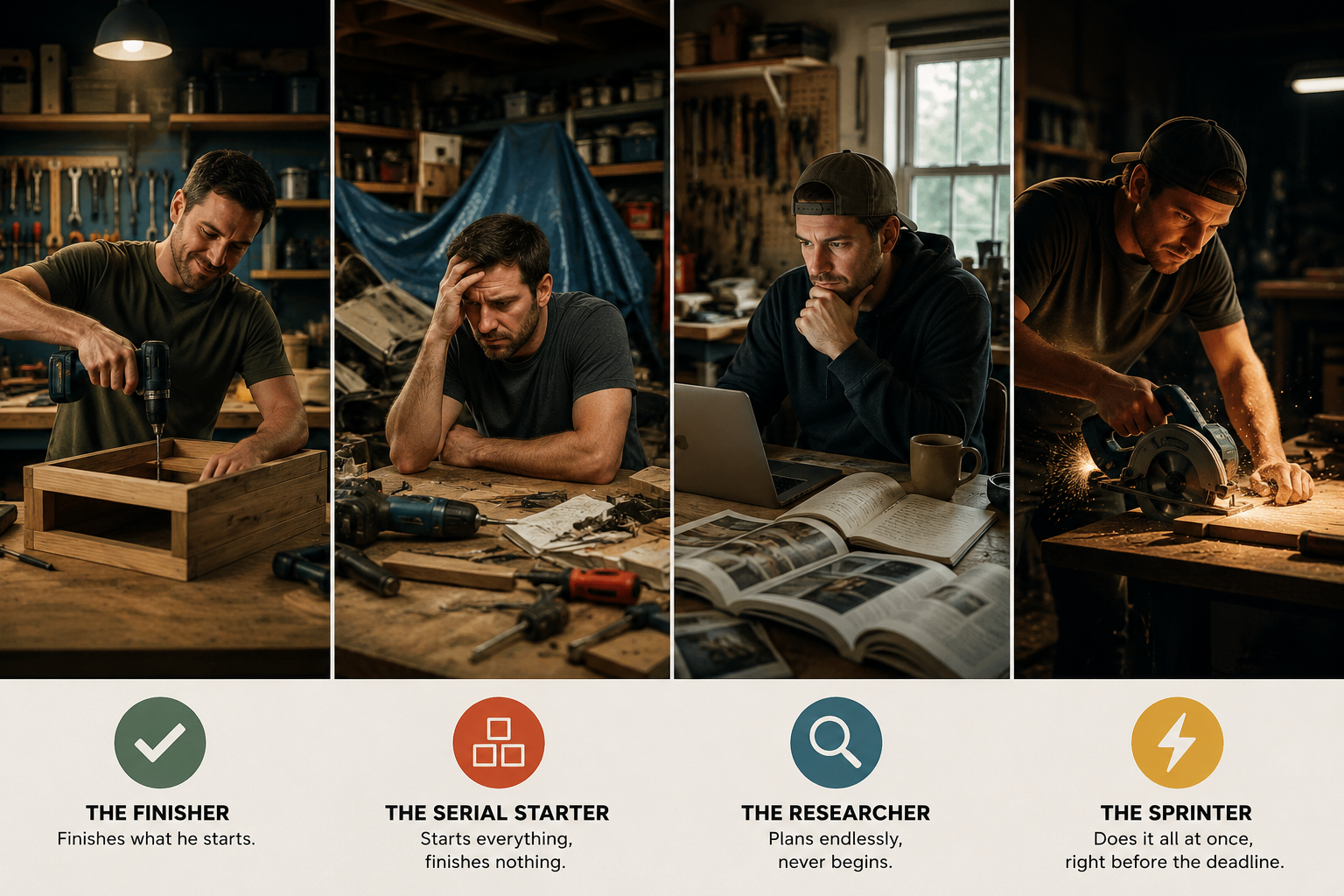
You've met all of these. You are probably one of them.
The natural finisher. Looks like discipline. Usually it's history. They've finished things before, so their expectancy is high, so starting feels lower risk, so they start, so they finish. It's a loop. The meta-analysis on self efficacy by Stajkovic and Luthans covered 114 studies and over 21,000 people and found a solid relationship between believing you can perform and actually performing. Confidence isn't the personality. It's the residue of finished projects.
The serial starter. Enormous energy on day one. Gone by week three. High Value, low Expectancy. They want the outcome badly, which is exactly why the size of the thing scares them off once the novelty burns away. These are the people with three half finished projects in the garage, and they're usually the hardest on themselves.
The staller. Never quite begins. Researching, planning, buying tools. This is task aversiveness plus ambiguity. A vague task has no first move, and a task with no first move reads to your brain as an infinitely big one. Stallers are not lazy. They're stuck at the definition stage and have mistaken it for a discipline problem.
The sprinter. Nothing happens until there's a deadline, then everything happens at once. High Impulsiveness. Ariely and Wertenbroch tested this at MIT in 2002 and found something useful: people who set their own spaced deadlines did better than people with one deadline at the end... but people given evenly spaced external deadlines beat both. Sprinters don't need more willpower. They need more checkpoints, ideally ones somebody else is watching.
These aren't rigid personality types, and I don't want to sell you a horoscope. Steel's data does show that conscientiousness and impulsiveness are real, stable traits that predict this stuff. Some of it is genuinely how you're wired.
But most of what separates a finisher from a staller on any given project is not wiring. It's whether the project was set up in a way a human being can actually execute.
Why some tasks are almost impossible to start
You can predict which projects will stall. They share a profile.
The next step is undefined. "Sort out the finances" is not a task. Your hands can't do it.
The payoff is months out. That's the Delay term, and it's a divisor. It doesn't reduce motivation... it divides it.
You have no proof you can do it. First time doing something means low expectancy by definition.
Progress is invisible. Weeks of work with nothing to look at is where most projects die.
There's something easier three feet away. Your phone wins every time the real task is vague.
And there's a specific trap in the middle. Bonezzi and colleagues published a paper in 2011 with the perfect title: "Stuck in the Middle." Motivation runs high at the start and high near the finish, and sags in the trough between, because the middle is far from both. Most projects don't die on day one. They die in month three.
What actually works
Ranked roughly by how strong the evidence is.
1. Write if-then plans.
This is the best supported self regulation tool in the field. Gollwitzer and Sheeran's meta-analysis covered 94 independent tests and found a medium to large effect. The format is fixed:
If [specific situation], then I will [specific action].
Not "I'll work on it this week." Instead: "If it's Saturday at 8am, then I go out and cut the two long pieces."
And write one for the obstacle too. "If it rains, then I do the prep work inside." You are handing the decision to the calendar so you don't have to make it while tired.
Two minutes of writing. Best return in this entire article.
2. Track it somewhere you can see it.
Harkin and colleagues reviewed 138 randomized studies covering about 20,000 people. Monitoring your progress reliably improved the odds of reaching the goal. And here's the part that matters: the effect was bigger when progress was physically recorded or reported to somebody else.
A wall calendar. A whiteboard. A photo log. Something you walk past. Thinking about your progress is not the same as recording it.
3. Cut the friction, not the excuses.
In 1965 Leventhal and his team ran a study at Yale on getting students vaccinated for tetanus. Scary pamphlets moved people's attitudes and intentions... but only about 3% actually showed up.
Then they added a campus map with the health center circled and asked students to pick a specific time. Compliance went to roughly 28%.
Same information. Same motivation. The map was the variable.
So: buy the materials Wednesday, not Saturday morning. Leave the next tool out. Clean the bench when you finish, not when you start. Every minute between "I have time" and "I'm working" is a minute you can talk yourself out of it.
4. Engineer a small win early.
Teresa Amabile collected nearly 12,000 daily diary entries from 238 people across 26 project teams. The single biggest driver of a good day was making progress on meaningful work. Bigger than recognition. Bigger than incentives.
Progress causes motivation. Not the other way around. So do the easy visible piece first, even if it's out of order, because you need the evidence more than you need the efficiency.
5. Give yourself a head start.
Nunes and Drèze ran a car wash loyalty card study in 2006. One group got an eight stamp card, empty. The other got a ten stamp card with two stamps already filled in. Identical work required. The pre-stamped group completed at 34% versus 19%.
Starting at zero is measurably harder than starting at two. So count the work you've already done. The research, the tool buying, the measuring... put it on the board.
6. Never miss twice.
One skipped session is noise. Two is a new pattern.
Cochran and Tesser called the collapse after a single slip the "what the hell" effect. You missed Saturday, so the project is off, so why bother Sunday. That story is what kills projects, not the missed day.
Phillippa Lally's habit study is the reassurance here. Her group found habits took a median of 66 days to become automatic, with huge variation between people... and critically, missing one single day did not derail the process.
By the way, the "21 days to form a habit" line you've heard your whole life traces back to a plastic surgeon's 1960 self help book. It isn't research.
7. Space out the checkpoints.
Back to Ariely and Wertenbroch. Evenly spaced deadlines beat one big deadline at the end. So don't set a finish date and hope. Set five dates between here and there, and tell somebody about them.
One thing to stop believing
You've probably heard that willpower is a battery that drains through the day. It's called ego depletion, it was everywhere for twenty years, and it did not hold up. A 23 lab replication with over 2,000 participants found essentially nothing. Twenty two of those 23 labs had predicted beforehand that it would work.
This matters because "I ran out of willpower" is a dead end. It tells you nothing to fix.
"The next step was undefined, the payoff was four months out, and I never wrote down when I'd do it" tells you exactly what to fix.
The short version
Take the project that's been sitting there. Do these four things this week.
Define the very next physical action, small enough that your hands could do it in under ninety minutes.
Write one if-then sentence saying exactly when and where you'll do it.
Put a tracker somewhere you walk past daily, and give yourself credit for what's already done.
Remove one piece of friction before Saturday gets here.
That's it. You don't need to feel ready. Readiness is what shows up after the third session, not before the first.
Stop saying someday. Start building.
Building, together. Daniel